Ergonomics & Recovery
Why Posture Matters: 7 Simple Ways to Improve Your Posture
Learn why posture matters and how simple changes can improve comfort, mobility, and physical well-being.
Introduction
Modern life makes it easy to spend hours sitting, looking at screens, driving, working at a desk, or repeating the same movements throughout the day. Over time, these habits can influence how we hold and move our bodies.
But posture is often misunderstood.
Good posture does not mean forcing your shoulders back, sitting rigidly upright, or trying to maintain one “perfect” position all day. Instead, healthy posture is better understood as a comfortable and adaptable way of positioning your body while allowing you to move freely.
The goal is not perfection. The goal is to create everyday habits that support comfort, movement, and function.
For people who spend much of the day at a desk, small adjustments to the workstation, regular changes in position, and more movement throughout the day can make a meaningful difference. Ergonomic guidance emphasizes neutral body positioning and appropriate adjustment of workstations to reduce awkward postures and unnecessary strain.
In this guide, we will look at why posture matters, what good posture actually means, and seven practical ways to improve your daily movement habits without becoming overly focused on “perfect” alignment.
🌿
Explore the Ergonomics & Recovery Hub
This article is part of our Ergonomics & Recovery Hub, where you’ll discover evidence-based guidance on posture, workplace ergonomics, movement, recovery strategies, musculoskeletal wellness, and healthy daily habits for lasting comfort and performance.
What Is Good Posture?
Posture refers to how you position and hold your body while sitting, standing, lying down, and moving.
There is no single posture that works perfectly for everyone or every activity. Your body needs to adapt when you walk, sit, lift, work, exercise, rest, or perform household tasks.
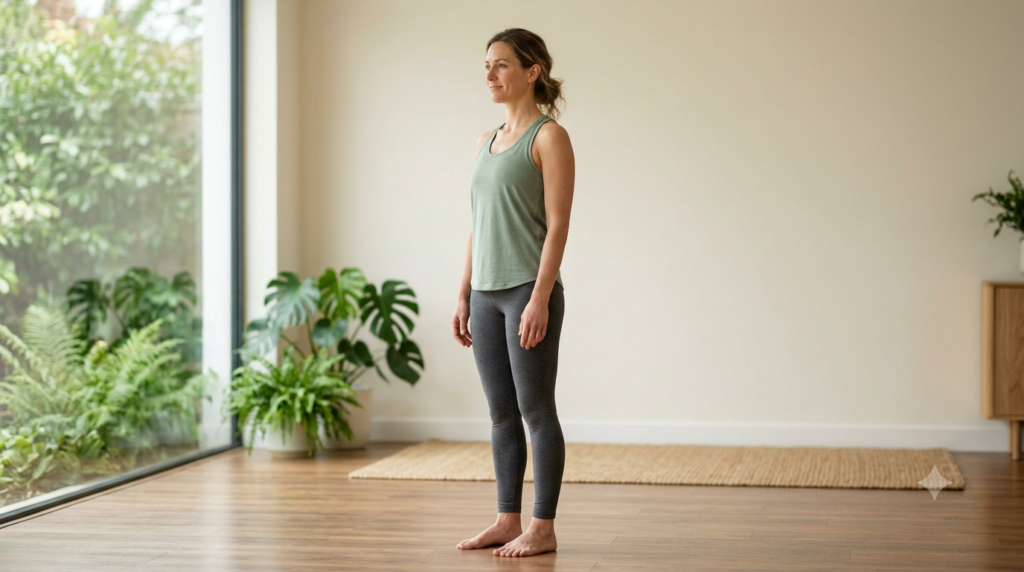
A useful concept is neutral positioning. In a neutral position, the body is arranged in a way that allows the joints and muscles to work comfortably without unnecessary awkward positioning.
For example, during computer work, a comfortable setup generally involves:
- Keeping the head balanced rather than constantly pushing it forward
- Keeping the shoulders relaxed
- Keeping the elbows reasonably close to the body
- Keeping the wrists relatively straight while typing
- Supporting the back appropriately
- Keeping frequently used items within comfortable reach
OSHA’s computer-workstation guidance describes neutral positioning as a comfortable working posture in which joints are naturally aligned and recommends adjusting the workstation to support that position.
The important point is that good posture should support movement rather than restrict it.
Why Does Posture Matter?
Posture influences how you interact with your environment.
When your workstation, chair, screen, or daily habits repeatedly place your body in awkward positions, certain muscles and joints may experience unnecessary stress or fatigue. A poorly arranged computer workstation, for example, can encourage awkward head, neck, shoulder, wrist, or back positions.
Good posture habits can therefore contribute to:
- Better everyday comfort
- More efficient movement
- A more supportive working environment
- Reduced exposure to awkward positions
- Greater awareness of how you sit, stand, and move
- Easier transitions between different activities
However, it is important not to turn posture into a source of anxiety.
You do not need to monitor your spine every second of the day.
Instead, think about variety, movement, support, and comfort.
How Modern Life Can Affect Posture
Our bodies are designed to move through many different positions.
Modern routines, however, can involve long periods of sitting and relatively little movement.
You might sit:
- At a computer for work
- During a commute
- While watching television
- Using a smartphone
- While studying
- During meals
- While browsing the internet
The problem is not that sitting itself is automatically harmful. The bigger concern is spending large amounts of time sedentary with little opportunity for movement.
The World Health Organization recommends limiting sedentary behaviour and replacing sedentary time with physical activity of any intensity where possible.
This is why improving posture should not simply mean “sit straighter.”
It should also mean:
Move more. Change positions. Adjust your environment. Build strength and mobility.
7 Simple Ways to Improve Your Posture
1. Set Up Your Workstation for Comfort
Your workstation can strongly influence your posture.
If your chair is too low, your desk is too high, or your screen is positioned awkwardly, you may naturally compensate by leaning, reaching, twisting, or raising your shoulders.
Start with the basics.
Check your chair
Your chair should allow you to sit comfortably with your feet supported and your back appropriately supported.
Your hips and knees should be positioned comfortably rather than forcing your body into an extreme angle.
Check your desk
Frequently used items should be within easy reach so that you do not repeatedly stretch or twist to access them.
Check your keyboard and mouse
Keep them close enough that your elbows can remain relatively near your body and your wrists can stay reasonably straight.
OSHA recommends arranging computer components to support neutral body positioning and reduce awkward reaching and wrist positions.
Practical tip:
Instead of trying to “fix” your posture while sitting at a poorly arranged desk, first improve the environment around you.
2. Position Your Screen at a Comfortable Height
A screen that is too high, too low, too far away, or positioned to one side can encourage awkward head and neck positions.
For most desktop setups, place the monitor directly in front of you rather than repeatedly turning your head toward it.
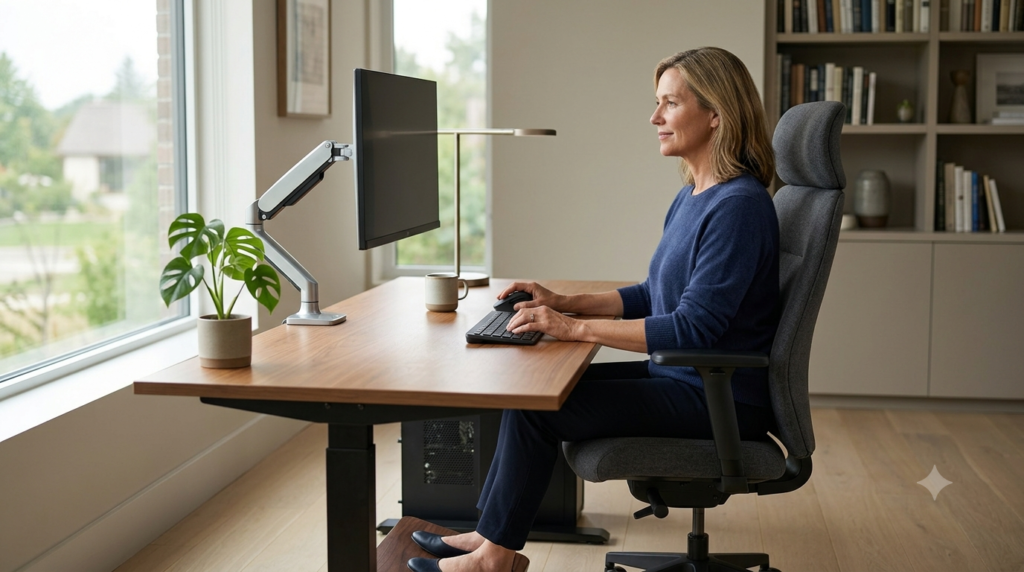
The top of the screen should generally be at or below eye level, while the viewing distance should allow you to read comfortably without leaning forward. OSHA’s monitor guidance recommends positioning the monitor to reduce awkward neck and torso positioning.
If you work primarily on a laptop, consider whether your screen and keyboard position force you to compromise.
A separate keyboard and mouse, together with an appropriately positioned screen, may allow you to create a more comfortable workstation.
Remember:
A good posture setup should make comfortable positioning easier—not require constant conscious effort.
3. Change Position Regularly
One of the simplest ways to improve your posture habits is to stop expecting one position to work all day.
Even a well-designed chair and workstation cannot eliminate the need for movement.
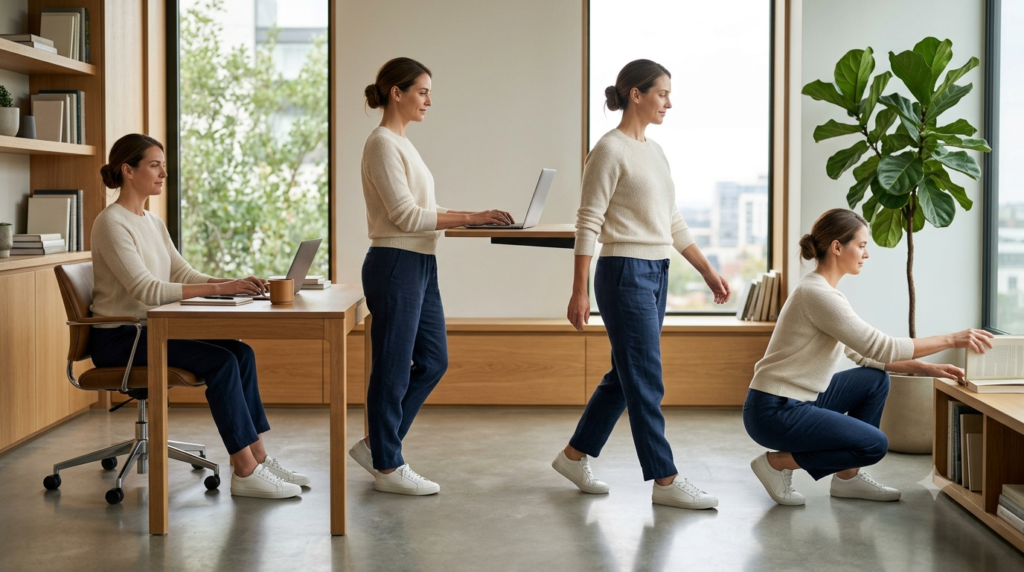
Try alternating between:
- Sitting upright
- Sitting slightly reclined
- Standing
- Walking
- Stretching gently
- Performing short non-screen tasks
OSHA recommends reducing long periods of uninterrupted computer work and incorporating short pauses or changes of activity.
You can create a simple habit:
Work → pause → move → return → repeat.
You do not need an elaborate routine.
Standing up to refill your water bottle, walking while taking a phone call, or spending a few minutes away from your screen can introduce useful movement into the day.
4. Take Short Movement Breaks
Movement breaks are especially valuable when your day involves prolonged sitting.
A movement break does not have to be a workout.

You could:
- Stand up
- Walk around the room
- Roll your shoulders gently
- Move your neck through a comfortable range
- Stretch your legs
- Walk to another room
- Perform a few gentle mobility movements
The purpose is simply to interrupt long periods of stillness.
The WHO guidelines emphasize that physical activity of different intensities counts and that reducing sedentary time is beneficial.
Practical tip:
Don’t wait until your body feels uncomfortable before moving.
Make movement a routine part of your working day.
5. Build Strength for Everyday Movement
Posture is not only about alignment.
Your ability to maintain comfortable positions also depends on your overall physical capacity.
Strength training can help you develop the muscles needed for everyday activities, while regular physical activity supports general physical function.
This does not mean you need an advanced gym program.
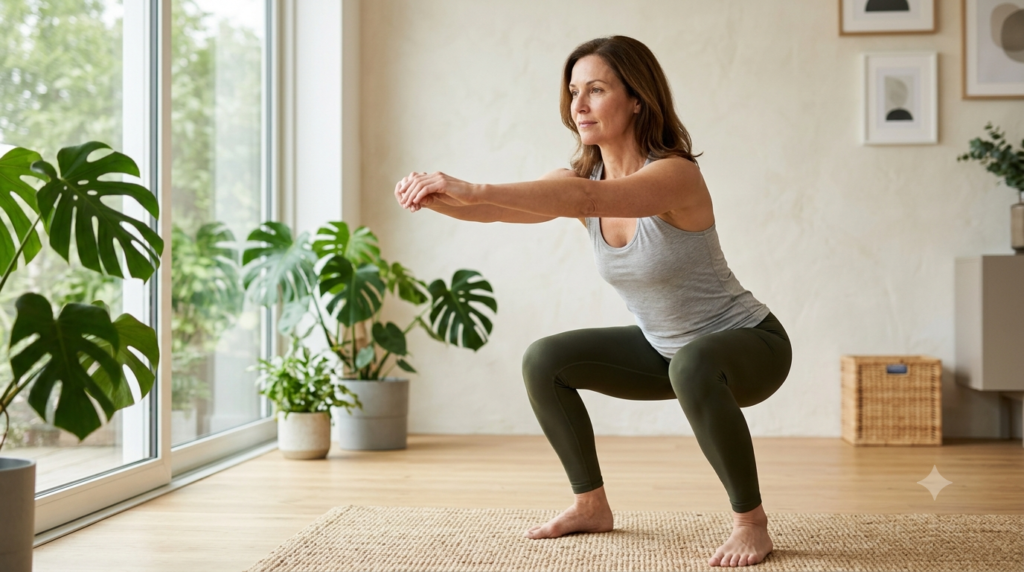
Depending on your ability and health status, basic movements such as:
- Squats
- Rows
- Hip hinges
- Push movements
- Carrying exercises
- Core exercises
can be incorporated into a balanced fitness routine.
WHO guidelines recommend muscle-strengthening activities for adults on at least two days per week as part of overall physical activity.
If you are new to exercise, start gradually and choose activities appropriate for your current fitness level.
6. Maintain Mobility
Strength and posture work best alongside movement variety.
If you spend much of your day in one position, gentle mobility exercises can help you regularly move your joints through comfortable ranges.
Consider including movements for:
- The neck
- Shoulders
- Upper back
- Hips
- Ankles
- Spine
The goal is not to force flexibility.
Instead, use controlled, comfortable movements that fit your ability.
A few minutes of mobility work can also provide a useful transition between long periods of sitting and more active parts of your day.
Think of mobility as movement practice—not punishment for having “bad posture.”
7. Develop Posture Awareness Without Becoming Rigid
This may be the most important habit of all.
Once you start thinking about posture, it can be tempting to constantly pull your shoulders backward, tighten your abdomen, straighten your spine, and hold yourself in one position.
That is not the goal.
Instead, develop simple awareness.
Ask yourself occasionally:
Am I comfortable?
Have I been in the same position for too long?
Could I adjust my chair or screen?
Could I stand up and move for a few minutes?
Is there a more comfortable way to perform this task?
This approach makes posture a practical movement skill rather than something you have to consciously control every moment.
Is There Such a Thing as “Perfect Posture”?
Probably not in the way many people imagine it.
Human bodies are constantly moving and adapting.
The ideal position for typing may not be the ideal position for reading. The position that feels comfortable while sitting may be completely different from the position you use while walking or exercising.
Even within one activity, changing position can be useful.
This is why the idea of maintaining one rigid “perfect posture” throughout the day can be misleading.
A better goal is comfortable, adaptable movement.
Good ergonomics also recognizes that there is no single workstation arrangement that fits every person. OSHA recommends using adjustable equipment and creating a workstation that can be adapted to the individual.
So instead of asking:
“Am I sitting perfectly?”
Try asking:
“Is my environment supporting comfortable movement, and have I been in this position too long?”
That is a much more useful question.
Posture and Prolonged Sitting: A Practical Daily Strategy
If you spend many hours at a desk, try this simple approach:
Every time you start work
Check:
- Chair
- Screen
- Keyboard
- Mouse
- Foot support
- Shoulder position
During your work
Remember:
Change position regularly.
During breaks
Try:
Stand → walk → move → return.
At the end of the workday
Ask:
How much movement did I get today?
This shifts the focus from obsessing over posture to improving your overall movement environment.
When Should You Seek Professional Help?
Posture advice is not a substitute for an individual medical assessment.
If you have persistent or worsening pain, significant weakness, numbness or tingling, symptoms following an injury, or difficulty performing normal daily activities, consider speaking with an appropriately qualified healthcare professional.
You should also seek professional advice if symptoms are severe, unusual, or continue despite reasonable changes to your daily habits.
The goal of this article is general education—not diagnosis or individualized treatment.
Key Takeaway
Good posture is not about holding your body in one perfect position all day.
It is about creating an environment that supports comfortable movement, changing positions regularly, staying physically active, developing strength and mobility, and paying attention to how your body feels.
Start small.
Adjust your workstation.
Move more often.
Take short breaks.
Build physical capacity.
And most importantly, don’t let the pursuit of perfect posture become another source of stress.
Your body was designed to move.
Frequently Asked Questions About Posture
Can poor posture cause pain?
Posture can influence how your body is positioned and how certain tissues are loaded, but pain is complex and usually has multiple contributing factors. It is not accurate to assume that one particular posture automatically causes pain.
If discomfort is persistent or worsening, professional assessment may be appropriate.
How often should I change my posture?
There is no universal interval that works for everyone.
Instead of focusing on a strict timer, avoid remaining in the same position for long uninterrupted periods. Short movement breaks and changes in activity can help reduce prolonged static positioning. OSHA recommends incorporating short pauses during computer work.
Can exercise improve posture?
Regular physical activity can support strength, mobility, coordination, and overall physical function.
Strength training that involves major muscle groups can be part of a balanced approach to physical health. WHO recommends muscle-strengthening activities for adults on two or more days each week.
Is there one perfect sitting posture?
No single sitting position is ideal for everyone or for every situation.
A comfortable, supported position that allows you to work without excessive awkwardness is generally more useful than trying to maintain one rigid position all day.
Changing positions is also important.
Can posture improve over time?
Yes, your movement habits and awareness can change with practice.
Improving your workstation, increasing physical activity, developing strength and mobility, and regularly changing positions can all contribute to healthier movement habits.
The goal is gradual improvement rather than perfection.
A Simple 5-Minute Posture Reset
If you’ve been sitting for a long time, try this simple reset:
1 minute: Stand and breathe comfortably.
1 minute: Walk around.
1 minute: Move your shoulders and upper back gently.
1 minute: Move your hips and legs comfortably.
1 minute: Return to your workstation and adjust your screen, chair, keyboard, or mouse if needed.
The purpose isn’t to “correct” your body.
It is simply to interrupt prolonged sitting and bring movement back into your day.
Final Thoughts
Your posture is part of how you interact with your environment, but it is only one piece of the bigger picture of physical well-being.
Rather than chasing a perfect alignment, focus on the fundamentals:
Move regularly.
Change positions.
Create a comfortable workstation.
Build strength.
Maintain mobility.
Listen to persistent symptoms.
Small changes repeated consistently can become powerful habits over time.
Medical Disclaimer
This article is provided for general educational and informational purposes only. It is not intended to diagnose, treat, cure, or prevent any medical condition and should not replace individualized advice from a qualified healthcare professional. If you have persistent, severe, worsening, or concerning symptoms, seek appropriate professional medical evaluation.
Continue Learning
You might also enjoy: